

Stony Plain Roofing
Precision roofing for homes and businesses in Stony Plain, built for Alberta weather.
Request a Quote


Roofers Stony Plain team provide roof repair and replacement services designed for Alberta’s wind exposure, snow loads, and aging housing stock. Durable materials, proper installation, and detailed inspections help extend roof lifespan and ensure reliable long-term performance.
Stony Plain is an established Alberta community with mature neighbourhoods, long-standing family homes, and newer residential development expanding along the outskirts. In this setting, roofing decisions are rarely about rapid construction – they are about durability, maintenance, and protecting structures that have stood for decades. At No Water Roofing, we work with homeowners and property managers who value practical, well-planned solutions. As experienced roofers in Stony Plain, we focus on extending roof service life where possible and recommending full replacement only when structural wear makes it necessary.

Roofing in Stony Plain — An Older Town With a Different Set of Challenges
Stony Plain isn’t a suburb. It’s a town with its own history, its own Main Street, and a housing stock that spans nearly a century of construction. That matters for roofing in ways that generic Alberta climate guides don’t capture.
The older core — homes built from the 1940s through the 1970s along and around the downtown corridor — carries roofing assemblies that reflect the standards of their era. Shallow pitches, minimal attic ventilation, and framing that was never designed around current insulation requirements are common. When these homes develop roofing problems, the fix is rarely just a surface replacement. Ventilation corrections, decking assessments, and sometimes structural reinforcement are part of the conversation before any new material goes on.
The newer residential growth on Stony Plain’s eastern and northern edges — developments that expanded through the 2000s and 2010s — brought different roofing profiles. Steeper pitches, more complex rooflines, and builder-grade asphalt systems that are now approaching their first maintenance window. These homes don’t have the structural complexity of the older core, but they sit in the same wind-exposed corridor and face the same Chinook and storm cycles without the benefit of the mature shelter belts that established agricultural properties in the area often have.
And then there’s the rural fringe — acreages, hobby farms, and agricultural properties on the outskirts where large workshop and barn roofs are as much a concern as the house itself. Flat and low-slope metal roofing on outbuildings in this corridor takes a significant beating from sustained wind and snow load, and it often goes uninspected for years longer than residential roofs would.
Roofing Services for Homes and Mixed-Use Properties in Stony Plain
In a community with mixed building ages, residential roofing needs vary significantly. Roof replacement in Stony Plain is common for homes built several decades ago that have reached the end of their design life. We also complete work on detached garages, additions, and light commercial properties.
/ how it works
A Simple, Transparent Roofing Process in Edmonton. No Surprises, No Pressure.

Book a Roof Inspection
We assess your roof and document any issues.

Get a Clear, Honest Estimate
Straightforward pricing with practical recommendations.

Approve the Right Solution
Choose what fits your needs, timeline, and budget.

Enjoy Completed Work + Digital Report
Proper installation with photo documentation and our No Leaks Guarantee.

Older structures with flat roofing often require careful evaluation of decking, ventilation, and flashing before new materials are installed. Some properties benefit from partial re-roofing to match existing systems, while others require a complete upgrade to improve durability and energy performance.
Why Wind Is Stony Plain’s Biggest Roofing Variable
Stony Plain sits in the same open prairie corridor as Spruce Grove — west of Edmonton, with nothing between it and the Rockies to interrupt the prevailing westerlies or slow a Chinook event before it arrives. What that means practically is that sustained wind load is a constant factor on every roof in this community, and Chinook events — which can shift temperatures 20°C or more within hours while bringing gusts well above 80 km/h — apply a compound stress that neither seasonal change nor a standard windstorm would produce on its own.
On older homes in Stony Plain’s established areas, this wind history has accumulated. Fasteners that were correctly installed decades ago have worked progressively looser through years of thermal cycling and wind load. Flashing at chimneys and penetrations has moved repeatedly with each Chinook event. What a roof inspection reveals on a 40-year-old Stony Plain home often reflects not one problem but the accumulated record of everything the roof has absorbed over its lifetime.
On newer homes and commercial properties, the concern is different — not accumulated history but whether the installation accounted for this corridor’s specific exposure. A roof installed to the minimum Alberta code will perform differently here than the same roof in a more sheltered community. Fastening density, edge termination detail, and underlayment selection all matter more when sustained wind load is part of the baseline rather than an occasional event.
Roofing Materials That Make Sense in Stony Plain
Asphalt shingles remain a practical solution for many neighbourhoods. Modern systems offer improved wind ratings and better resistance to temperature fluctuations.
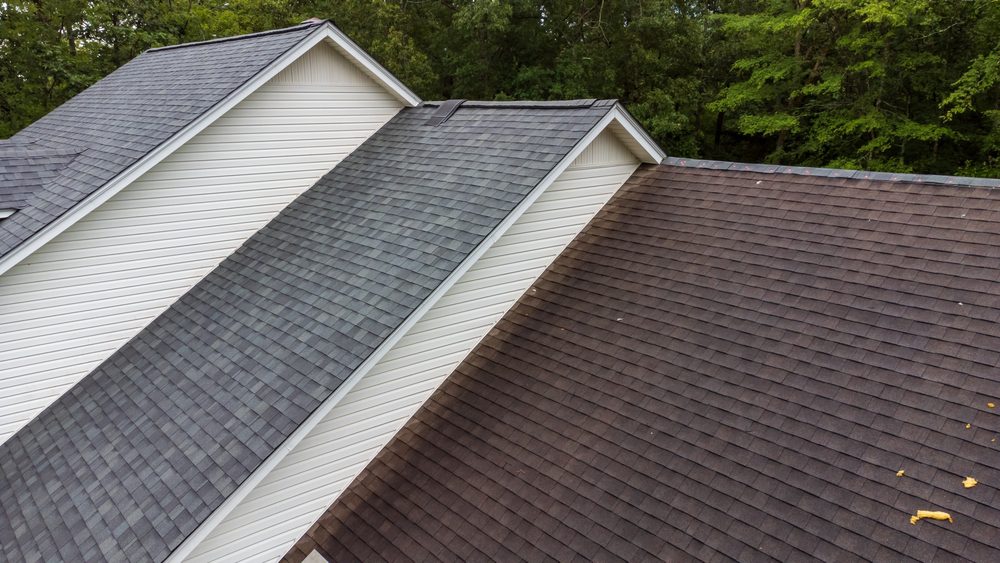
For extended durability, metal roofing in Stony Plain is increasingly popular. Proper fastening methods and underlayment selection are critical for long-term performance, particularly in areas exposed to sustained wind loads.
Wind and snow accumulation both place structural stress on roofing assemblies over time. Long-term durability depends on correct load assessment and installation standards suited to Alberta’s climate.
What Roofing Work Looks Like for Different Property Types in Stony Plain
| Property type | Common roofing profile | What to watch for |
|---|---|---|
| Older downtown-area homes (pre-1980) | Original or once-replaced shingles, minimal attic ventilation, shallow pitch common | Ice dams, attic moisture, decking condition before any replacement |
| Newer subdivision homes (2000s–2010s) | Builder-grade asphalt shingles, steeper pitch, more complex rooflines | First maintenance window arriving — edge and flashing wear from wind exposure |
| Acreages and rural residential | Mix of pitched residential and outbuilding roofs, sometimes metal on workshops | Outbuildings often inspected infrequently — wind and snow load damage accumulates |
| Commercial and Main Street properties | Flat roofing common — torch-on and older BUR systems on established buildings | Drainage failures, membrane age, seam stress from thermal cycling |
| Agricultural outbuildings | Large metal or low-slope roofing on barns and workshops | Fastener pull-out, panel movement, seam separation from sustained wind load |
Why Experience Matters for Roofing Projects in Stony Plain
Working on aging homes requires more than surface replacement. Roofers in Stony Plain must understand how existing framing, ventilation systems, and decking conditions affect performance.
Before recommending replacement, we evaluate structural integrity and identify any reinforcements needed. Proper preparation reduces surprises during construction and helps ensure the finished roof performs as intended for years to come.
Further Reading for Stony Plain Property Owners
These articles cover the conditions and decisions most relevant to properties in Stony Plain’s wind-exposed, mixed-age community.

Certified & Safety-First
COR (R) certified, ARCA and OH&S compliant on every project.
Detail-Focused Workmanship
We spend time where leaks actually start – penetrations, edges, transitions.
No Water. No Leaks. Guaranteed.
If water gets in, we make it right. Period.
Digital Transparency
Photo documentation and digital reports for full accountability.
Reliable Roofing Contractors in Stony Plain
Roofing in Stony Plain is a long-term investment shaped by climate, exposure, and steady seasonal stress. Whether you are planning repairs or a full system replacement, the goal is consistent protection and reliable performance. If you are considering roofing work, contact No Water Roofing to schedule an inspection and receive a detailed estimate for your property.
FAQ
1. How does Stony Plain’s wind exposure affect how long a roof lasts?
Meaningfully. Stony Plain sits in the same open prairie corridor as Spruce Grove — one of the most wind-exposed positions in the Edmonton region. Sustained westerly winds and periodic Chinook events apply repeated stress to edges, flashings, and fasteners that doesn’t show up in standard material lifespan estimates. A builder-grade shingle system rated for 25 years may approach its practical maintenance window closer to 18–20 years on a home with full western exposure and no natural windbreak. Installation quality — specifically fastening density and edge termination detail — has more impact on lifespan here than in more sheltered communities.
2. What’s the most common roofing problem on commercial properties in Stony Plain?
Flat roof drainage failure is the most common issue on commercial and Main Street properties in Stony Plain. Many of these buildings carry older torch-on or BUR systems that are approaching or past their original service life. Blocked or degraded drainage, seam separation from years of thermal cycling, and membrane surface wear that hasn’t been addressed through regular maintenance are the recurring patterns. The issue is often compounded by the fact that commercial flat roofs in smaller towns tend to get inspected reactively — when something leaks — rather than proactively.
3. Can I get roofing work done in Stony Plain during winter
Some roofing work can be completed in winter conditions — emergency repairs, targeted maintenance, and certain flat roof systems can be addressed in cold weather with the right materials and precautions. Full shingle replacements are generally better suited to above-freezing temperatures for adhesive performance and safe working conditions. If you’re planning a replacement and your roof is showing signs of active damage going into winter, it’s worth having the situation assessed — waiting until spring with a compromised roof adds risk through the freeze-thaw season.
/ testimonials
Trusted by Edmonton Homeowners & Businesses
125 Google Reviews


/ service areas
Proudly Serving Edmonton & Surrounding Areas
We provide professional roofing services across Edmonton and nearby communities, delivering the same certified workmanship and No Leaks Guarantee on every project.


